Forty years of IP strategy, patent portfolio management, and innovation leadership — now available directly to you. I work with startups, inventors, and established companies to protect and maximize the value of their ideas.
The USPTO recently issued guidelines on practitioners' use of AI in patent and trademark practice. This article examines what these Practitioner Guidelines mean for inventors, counsel, and the future of patent prosecution.
Read on LinkedIn →From early-stage invention disclosure through global portfolio optimization, I help clients build IP assets that align with business objectives and create real competitive advantage.
AI is reshaping how inventions are conceived, documented, and prosecuted. I advise technology companies and AI developers on navigating USPTO guidelines, inventorship questions, and AI-assisted claim drafting.
Working directly with inventors to identify protectable innovations, structure disclosure, and develop prosecution strategies — especially for software, design, and utility patents.
A genuine passion of mine. I bring deep domain knowledge to cycling-related inventions — from e-bikes and connected mobility devices to cycling apparel and component technology.
An analysis of the USPTO's new Practitioner Guidelines on AI use in patent and trademark practice — and what they mean for the profession going forward.
Read on LinkedIn →My submitted comments to the USPTO's Request for Comments on how AI proliferation affects the knowledge of a person having ordinary skill in the art (POSITA) — including a call to sign on.
Read on LinkedIn →A forward-looking piece on the imperative for the USPTO to expand its use of AI to remain competitive — and what that means for the next Under Secretary of Commerce for Intellectual Property.
Read on LinkedIn →A practical breakdown of the UPC's landmark first decision on FRAND licensing of standard-essential patents and its implications for international IP strategy.
Read on LinkedIn →The Federal Circuit's landmark en banc decision in LKQ Corp. v. GM Global Technology Operations LLC (2024) fundamentally changed the nonobviousness standard for design patents. Here's what it means for design patent owners.
Read on LinkedIn →Published in Intellectual Asset Management on May 31, 2006, this article describes how Ford Global Technologies and British American Tobacco collaborated to create the intellectual asset management platform that ultimately became Anaqua. The article examines the evolution of enterprise IP management, integrated licensing and enforcement systems, and the growing strategic importance of intellectual asset management for global companies.
View Publication →Damian is not only an IP advisor — he's an inventor. The following patents reflect work spanning IP management software, legal workflow tools, automotive technology, and accessibility systems.
| Patent No. | Title | Assignee | Grant Date |
|---|---|---|---|
| US 10,449,968 | Methods and apparatus for adaptively assisting developmentally disabled or cognitively impaired drivers | Ford Motor Company | Oct 22, 2019 |
| US 9,053,447 | Method and system for automated messaging in an online legal workflow tool | Porcari / Dinsdale | Dec 27, 2012 (filed 2003) |
| US 8,429,723 | Method and system for role-based access control to a collaborative online legal workflow tool | Porcari / Dinsdale | Apr 23, 2013 |
| US 9,384,455 | On-line invention disclosure system | — | Issued |
| US 7,376,635 | Theme-based system and method for classifying documents | Ford Global Technologies, LLC | May 20, 2008 |
| US 7,069,592 | Web-based document system | Ford Global Technologies, LLC | Jun 27, 2006 |
| US 2004/0122841 | Method and system for evaluating intellectual property | Ford Motor Company | Published 2004 |
| US 2012/0240026 | Method and system for related art citation management | Anaqua, Inc. | Published 2012 |
| GB 2,368,673 | Online invention disclosure system with search function | Ford Global Tech Inc | May 8, 2002 |
| GB 2,368,672 | Online invention disclosure system | Ford Global Tech Inc | May 8, 2002 |
I’m an independent intellectual property advisor with over 40 years of experience helping companies and inventors turn ideas into protected, commercially valuable assets.
At Ford Global Technologies, I invented and created the intellectual asset management platform that became Anaqua. The project began as a collaboration between Ford and British American Tobacco to solve a problem no commercial system then addressed: managing inventions, patents, trademarks, agreements, conflicts, and licensing in one integrated global system. The system evolved into a standalone company now used by many of the world’s largest patent and trademark owners. Microsoft was among Anaqua’s early enterprise customers, and the platform has since become one of the leading global IP management systems.
I also served as Ford’s Director of Licensing and Enforcement, leading major intellectual property enforcement efforts against the automotive aftermarket parts industry, including litigation involving companies such as Keystone and LKQ. Those efforts helped establish and reinforce the legal principle that automotive replacement body parts can qualify for design patent protection and that unauthorized aftermarket copies may infringe those rights. Federal Circuit decisions involving Ford’s enforcement program became landmark cases in modern automotive design patent law and continue to shape the industry today. The impact of those cases has been significant enough that aftermarket and insurance industry groups have continued for decades to support legislative efforts, including versions of the proposed PARTS Act, seeking to limit or narrow design patent protection for automotive collision repair parts.
I later served as Regional Director of the Midwest Regional Office of the United States Patent and Trademark Office. In that role, I worked directly with corporations, law firms, universities, inventors, and entrepreneurial organizations throughout the nine Midwestern states served by the office. I also oversaw operations of the USPTO’s Detroit office, including regional Patent Trial and Appeal Board activities and patent examination operations. The role provided a unique opportunity to engage with innovators at every level, from Fortune 500 companies to first-time inventors and startup founders.
My broader background spans IP strategy, design and software patents, licensing programs, global portfolio management, enforcement, and IP management software. I have worked inside Fortune 500 boardrooms, advised technology startups, and collaborated with inventors developing genuinely new technologies.
I hold a law degree from the University of Detroit Mercy School of Law and am based in Hallandale Beach.
Outside of IP, I’m passionate about cycling and mobility technology, and I have a particular interest in cycling-related inventions and transportation innovation.
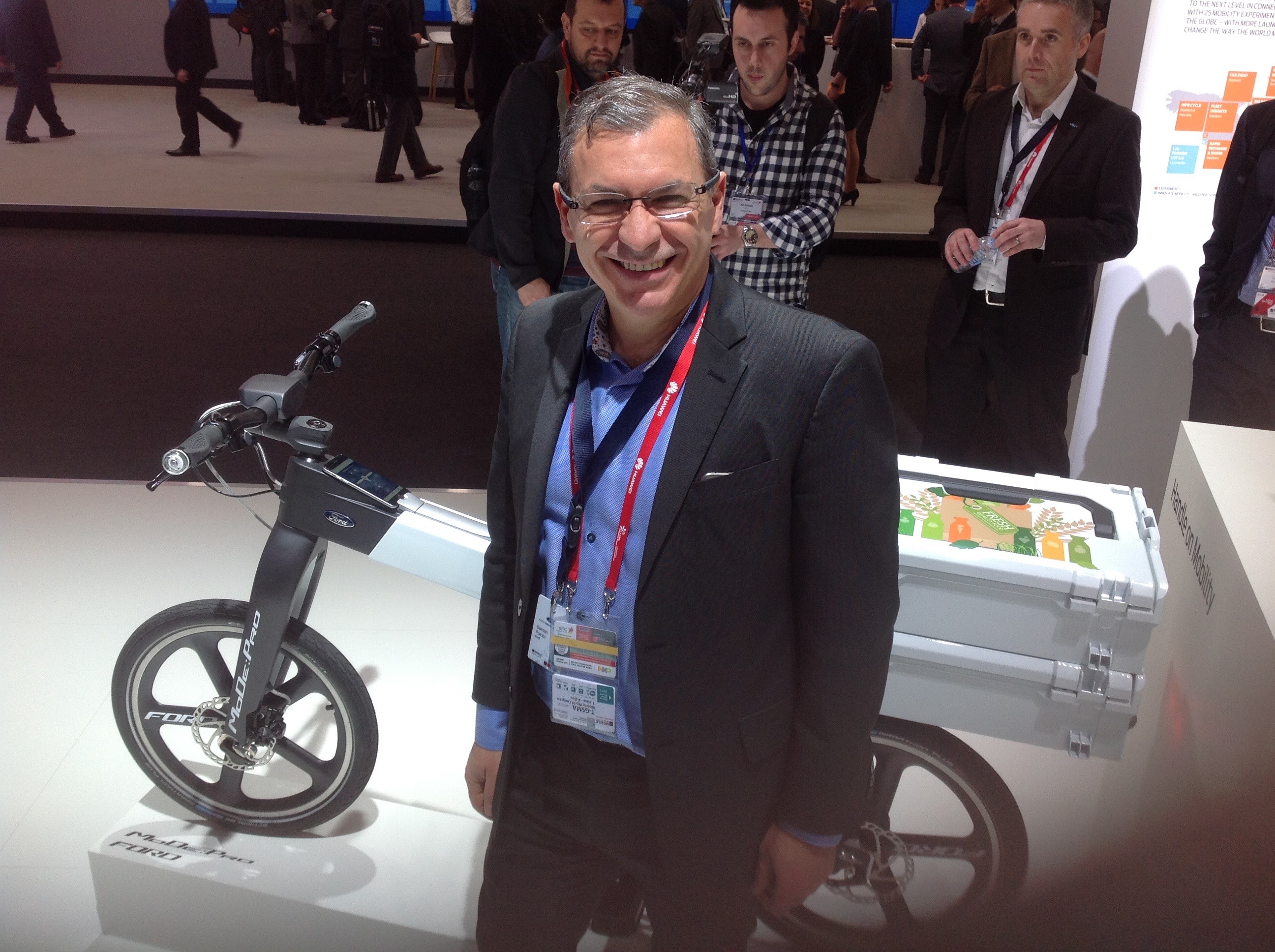
In 2015, I served as Project Manager for Ford's Handle on Mobility innovation program — a company-wide competition soliciting ideas from Ford employees for revolutionary mobility devices that could integrate seamlessly with Ford vehicles.
Over 100 submissions were received. The winning concepts — the MoDe:Me (a foldable urban commuter e-bike) and the MoDe:Pro (a commercial-use e-bike designed to stow in Ford vans) — were developed into working prototypes and unveiled at Mobile World Congress 2015 in Barcelona, where they won Best Product Design.
The bikes featured 200W pedal-assist motors, heart-rate-adaptive pedal assist, haptic handlebar alerts, ultrasonic hazard sensors, and deep integration with Ford's SYNC platform — a vision of the connected, multi-modal transport future.
Read the New Atlas coverage →Whether you have a pending patent question, a portfolio to evaluate, or an invention on a napkin — I'm happy to have a conversation.
dporcari@gmail.com Connect on LinkedIn